2026 International Youth Forum: Embracing Every Brain
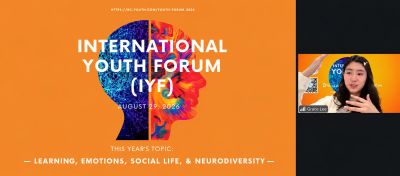
On August 29, 2026, BC Children & Youth Connection Society hosted its International Youth Forum online. Twenty presenters from Canada, the United States, and China shared perspectives on how cognition, emotions, social experiences, and neurodiversity shape young people’s lives.
Under the theme Embracing Every Brain, the forum explored questions that matter in everyday life: How do we learn and make decisions? How does pressure affect our emotions? How can differences in communication and social experience influence a young person’s sense of belonging?
The discussion brought together perspectives from different countries and backgrounds. It offered an opportunity to listen to one another, examine familiar assumptions, and consider how schools and communities can better support different ways of thinking, learning, and connecting.
For our youth-led Canadian non-profit organization, the forum is part of an ongoing commitment to making space for young people’s voices. We thank the presenters, youth volunteers, and supporters who helped make this year’s event possible. We look forward to continuing these conversations and turning what we learn into practical steps toward more inclusive communities.
Sponsored by the Leadership & Innovation Lab
Thank you for your support!


Thank You, Foundry
Our heartfelt thanks to Foundry for its warm support of the International Youth Forum 2026. We truly appreciate your kindness and encouragement.
Welcome to the 2026 International Youth Forum (IYF)

The 2026 International Youth Forum (IYF)
- The 2026 International Youth Forum is a youth-led event that invites students from diverse backgrounds to explore issues that shape the mental health and well-being of today’s youth.
- Since 2021, our annual International Youth Forum has connected youth and speakers from Canada, the United States, Singapore, and South Africa for interdisciplinary dialogue on issues that matter to young people and how we can turn ideas into action.
- This year’s theme, Healthy Minds: Learning, Emotions, and Social Life, dives into how learning, emotions, relationships, and social environments influence the mental health and everyday experiences of our youth. The forum will explore topics like stress, anxiety, social connection, digital lives, and artificial intelligence. To better understand the opportunities and challenges that young people face in a rapidly changing time, we will examine cognitive, developmental, and social psychology.
- The forum will also explore the mental health and lived experiences of neurodivergent youth, examining the real-world challenges they face in learning, communication, participation in social environments, and relationships. We will discuss how greater understanding, inclusion, and helping others feel like they belong can help create a more supportive educational and social world.
- With interdisciplinary dialogue, research presentations, and inquiry, participants are encouraged to better understand themselves and others, further their awareness of mental health and human diversity, and explore ways to support the well-being and healthy development of our youth.
Online Forum Schedule
Vancouver (PDT, UTC−7)
Saturday, August 29, 2026
9:30 AM – 12:30 PM
Location
Online (via Zoom)
What This Forum Explores
- Mental Health and Well-Being
- Learning, Cognition, and Decision-Making
- Emotions, Stress, and Resilience
- Social Relationships and Belonging
- Youth Development in the Digital Age
- AI, Social Media, and Technology
- Neurodiversity and Inclusion
- Communication, Understanding, and Participation
What You Will Experience
- Youth-Led Research Presentations
- Perspectives from Psychology and Social Sciences
- Conversations on Mental Health and Well-Being
- Exploration of Neurodiversity and Inclusion
- Reflection on Learning, Emotions, and Social Life
- Cross-Cultural Dialogue and Shared Inquiry
Expression Formats and Duration
While PowerPoint presentations will be the primary format, participants are also encouraged to express their ideas and values through a variety of creative forms, including news broadcasts, interviews, poetry, drama, animation, storytelling, documentaries, posters, artwork, skits, music, songs, short films, debates, podcasts, and photography.
Participation
- We welcome applications from individuals, experts, teams, youth clubs, schools, nonprofits, organizations, professionals, educators, parents, researchers, community leaders, policymakers, and volunteers worldwide.
- Whether you join as a participant or as a representative of your community, you will engage with diverse perspectives and contribute to developing more thoughtful and effective ways of understanding and communicating, helping to foster greater inclusion and equity.
- Contact us at: bcyouthsince2017@gmail.com
Contact
If you are interested in joining as an individual representative, team, non-profit, campaign, school, or club, please reach out at bcyouthsince2017@gmail.com for further inquiries. Your voice helps us understand you better.
Questions?
Please reach out to the contacts below if you have any questions or need clarification. Our team is happy to help and we’d love to see you and your team at the IYF 2026!
- BC Youth HR Leadership Team – IYF Responders bcyouthsince2017@gmail.com
Team Leaders

Grace Lee
Caroline Rickards
Caroline Rickards
Caroline Rickards
Caroline Rickards
Caroline Rickards
Lulu Jamal
Caroline Rickards
Lulu Jamal
Youth Leadership Team
Emily Liu
Chelsea Jiang
Chloe Jong
Chloe Jong
Chelsea Jiang
Chloe Jong
Keeri Reddy
Chelsea Jiang
Chelsea Jiang
Chelsea Jiang
Chelsea Jiang
Chelsea Jiang
Queeny Li
Jocelyn Niu
Jocelyn Niu
Jocelyn Niu
Jocelyn Niu
Jocelyn Niu
Olivia Lu
Jocelyn Niu
Felix Sheng
Felix Sheng
Jocelyn Niu
Felix Sheng
Jadeon Smith
Jadeon Smith
Jadeon Smith
Mila Sheng
Jadeon Smith
Jadeon Smith
Juniper
Jadeon Smith
Rofell Zheng
Rofell Zheng
Jadeon Smith
Rofell Zheng